
What it covers
Kit that lifts or lowers a load.
LOLER is the Lifting Operations and Lifting Equipment Regulations 1998. It applies to equipment that lifts or lowers loads, and a person counts as a load. HSE lists these as lifting equipment in arboriculture:
- Climbing systems: ropes, harnesses, lanyards and strops, karabiners and other connectors, and anchor points.
- Rigging systems for lowering branches and sections: rigging ropes, slings, blocks and lowering devices.
- Mobile elevating work platforms (MEWPs) and cranes.
- Other machines that lift, such as tree spades.
Winching at ground level, where the load never leaves the ground, isn’t lifting equipment.
How often
Every 6 or 12 months.
Kit that is exposed to wear has to have a thorough examination at these intervals, or at the intervals in a written examination scheme drawn up by a competent person:
| Equipment | Thorough examination | Examples |
|---|---|---|
| Used to lift people | At least every 6 months | Climbing ropes, harnesses, lanyards, connectors, MEWPs |
| Lifting accessories | At least every 6 months | Slings, karabiners and blocks used in rigging |
| Other lifting equipment | At least every 12 months | Cranes and other lifting machines |
New kit needs an examination before first use unless it comes with a declaration of conformity made in the last 12 months. Kit also needs examining after anything that could have affected its safety, such as a shock load or a fall.
Checks and examinations
Three levels of checking.
| Check | Who does it | When |
|---|---|---|
| Pre-use check | The person using the kit, trained to do it | Every day, by eye and by hand, before use |
| Written inspection | A trained person | Weekly for high-wear items such as ropes, according to HSE |
| Thorough examination | A competent person, with a written report | Every 6 or 12 months, or as the examination scheme says |
Pre-use checks and weekly inspections catch damage between examinations. They don’t replace the thorough examination.
Who can examine
A competent person.
HSE describes a competent person as someone with enough practical and theoretical knowledge and experience of the equipment to find defects and judge how serious they are. They can work for you, but they must be independent enough to examine the kit without fear or favour, and they shouldn’t be the person who maintains it.
In arboriculture, examiners usually hold the City & Guilds NPTC Level 3 Certificate of Competence in Thorough Examination of Arboricultural Equipment, or the Lantra Level 3 Award in Thorough Examination of Arboricultural Lifting Equipment.
The report
What the examiner gives you.
The written report of a thorough examination has to include, among other things:
- Your name and address, and where the examination took place.
- What the equipment is, with enough detail to identify it, and its safe working load.
- The date of this examination and of the previous one.
- Whether it's safe to use, and any defect that is or could become a danger, with any repair needed and by when.
- The latest date for the next thorough examination.
- The examiner's name, address and qualifications, and who they work for.
If the examiner finds a defect that is a danger, they must tell you straight away, and you must not use the kit until it’s put right. If there’s a risk of serious injury, they also send a copy of the report to the enforcing authority.
Records
How long to keep reports.
| Report | Keep it |
|---|---|
| Before first use, for most equipment | Until you stop using the equipment |
| Before first use, for lifting accessories | Two years |
| Periodic thorough examinations | Until the next report is made, or two years, whichever is later |
| Declaration of conformity from the maker | For as long as you use the equipment |
A register with one line per item makes it easy to see what’s due and to show an inspector or a client that the kit is in date. Mark anything that fails, take it out of use straight away and keep it apart from usable kit.
The free register
A kit register you can print.
The download is two A4 landscape pages:
- A register for 15 items: ID or serial number, date into service, last thorough examination, next due, pass / defect / fail, examiner and notes.
- A pre-use check list for ropes, harnesses, connectors, pulleys and rigging kit.
- A weekly rope inspection log.
In Treetask
Your kit list, with due dates and reports.
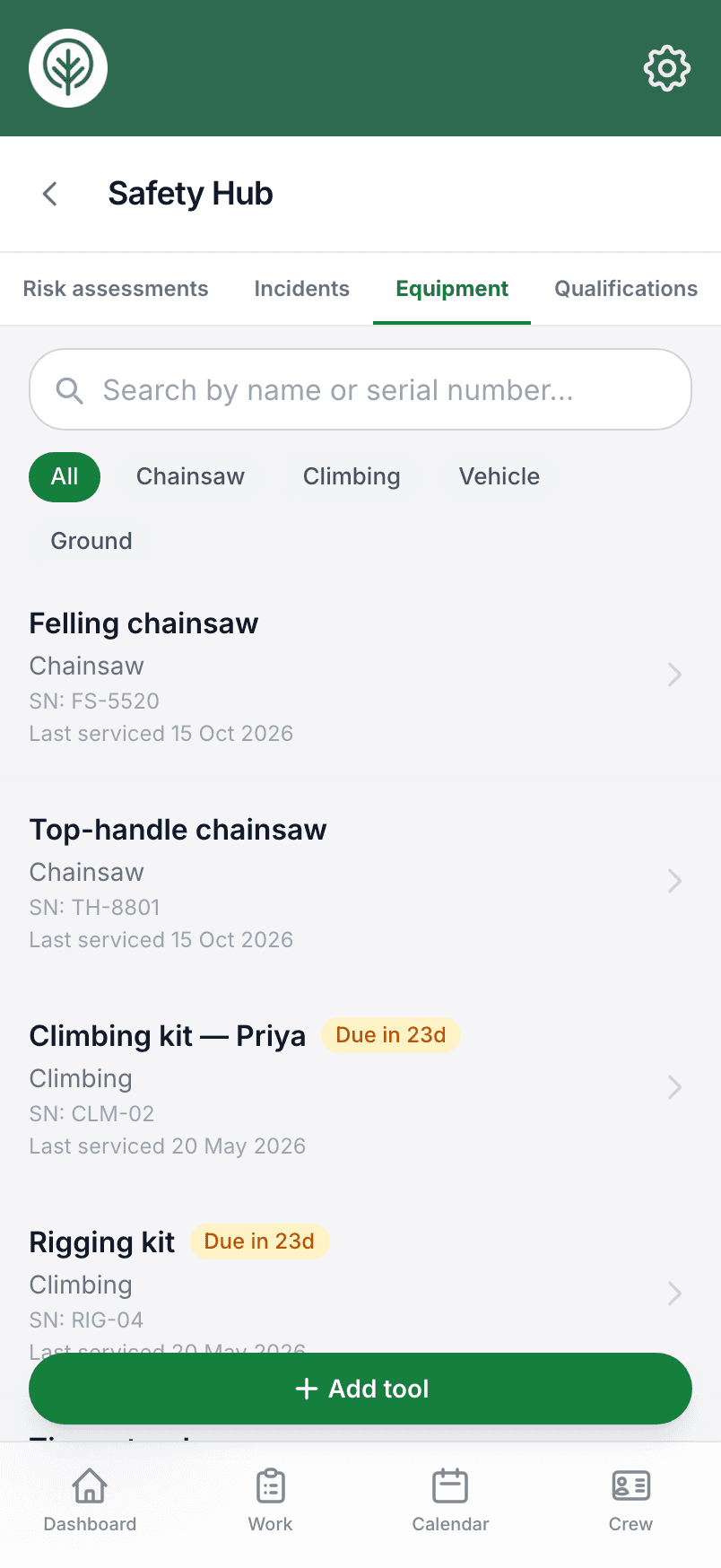
Treetask keeps a list of your kit with an inspection interval and next due date for each item, and reminds you before it's due. Log a service or an examiner's visit with the date, the outcome and the report attached; a fail takes the item out of service. Each item can have its own checklist, and its full service history stays with it.
This guide summarises LOLER and HSE guidance for tree work. It isn’t legal advice. Your examiner can tell you whether your kit needs a written examination scheme or shorter intervals.