
The law
Why the tickets matter.
The Provision and Use of Work Equipment Regulations 1998 (PUWER) require employers to make sure anyone using work equipment has had adequate training. For chainsaws, HSE’s guidance goes further: anyone using a chainsaw on or in a tree should have had appropriate training and hold a relevant certificate of competence or national competence award. The exception is someone in training, supervised by a competent person who holds the certificate.
A certificate shows the person met the standard on the day they were assessed. Whether they’re competent for a particular job, such as a big dismantle over a roof, is still the employer’s judgement.
The main units
Old CS codes and current qualifications.
Most of the trade still uses the old CS codes. City & Guilds now issues each unit as its own certificate with an 0039 number. Older certificates may show a CS code or an NPTC unit number instead, and qualifications gained before the changes in 2012 remain valid.
| Common name | City & Guilds qualification | What it covers |
|---|---|---|
| CS30 | 0039-20 Chainsaw Maintenance and Cross-cutting (Level 2) | Maintaining a chainsaw and cross-cutting timber on the ground. Usually the first chainsaw ticket. |
| CS31 | 0039-21 Felling Small Trees up to 380mm (Level 2) | Felling and processing trees up to 380mm. |
| CS32 | 0039-33 Felling and Processing Medium Trees over 380mm and up to 760mm (Level 3) | Felling and processing medium trees. |
| — | 0039-34 Felling and Processing Large Trees over 760mm (Level 3) | Felling and processing large trees. |
| CS38 | 0039-22 Climbing Trees and Aerial Rescue (Level 2) | Climbing on a rope and harness and rescuing a casualty from the tree. No chainsaw use. |
| CS39 | 0039-23 Using a Chainsaw from a Rope and Harness (Level 2) | Using a top-handled saw in the tree, including removing branches. |
| — | 0039-31 Aerial Tree Pruning (Level 3) | Pruning work in the crown. |
| CS41 | 0039-32 Aerial Tree Rigging (Level 3) | Lowering sections and branches with rigging. |
| — | 0039-38 Use of a Chainsaw from a MEWP (Level 3) | Chainsaw work from a mobile elevating work platform. |
Who needs what
Tickets by role.
This is what clients and insurers usually expect to see. Your own risk assessment for the work decides what each job needs.
| Role | Usually holds |
|---|---|
| Groundworker using a saw | CS30 and CS31, with CS32 for bigger trees. |
| Climber | CS30, CS31, CS38 and CS39. |
| Climber doing rigging or sectional dismantling | The climber's tickets plus CS41. |
| Chainsaw work from a MEWP | 0039-38, plus IPAF training for the category of platform used. |
| Chipper, stump grinder or brushcutter | Training and assessment for that machine, from City & Guilds NPTC or Lantra Awards. |
| Work on or next to a road | Chapter 8 training for signing, lighting and guarding. |
| First aider on site | Emergency First Aid at Work or First Aid at Work with the forestry add-on (+F). |
Work on Forestry Commission land requires a first aid certificate with the +F add-on, which covers catastrophic bleeding and remote sites. Many other clients ask for it too.
Refreshers
When to plan refresher training.
City & Guilds NPTC chainsaw certificates have no expiry date. Refresher training is still expected:
| Source | What it says |
|---|---|
| HSE, Chainsaws at work (INDG317) | Refresher training every two to three years for occasional users and every five years for full-time users. |
| FISA guidance | Refresher training at least every five years for most machinery work, chainsaw and aerial tree work included. |
| Management of Health and Safety at Work Regulations 1999 | Training to be repeated periodically where appropriate. |
Some clients set their own rule. Forestry England, for example, asks chainsaw operators for formally recorded training within the last five years. First aid certificates are different: HSE says a first aid at work certificate lasts three years.
Keeping records
What to keep on file.
HSE expects employers to record and plan refresher training. Councils, managing agents and main contractors often ask for copies of the crew’s tickets before work starts, and an insurer will ask for them after an incident. Keep a copy of every certificate, and a record of refreshers and aerial rescue practice.
The free record sheet keeps the whole crew on one page:
- 1Write one line per certificate, not one per person.
- 2Copy the qualification as it appears on the certificate, with both the CS code and the 0039 number if it shows them.
- 3Fill in the date passed, and the date you plan the next refresher.
- 4Tick the box once a copy of the certificate is on file.
- 5Check the sheet when someone joins, passes a new unit or is coming up to a refresher.
In Treetask
Every crew member's tickets in one place.
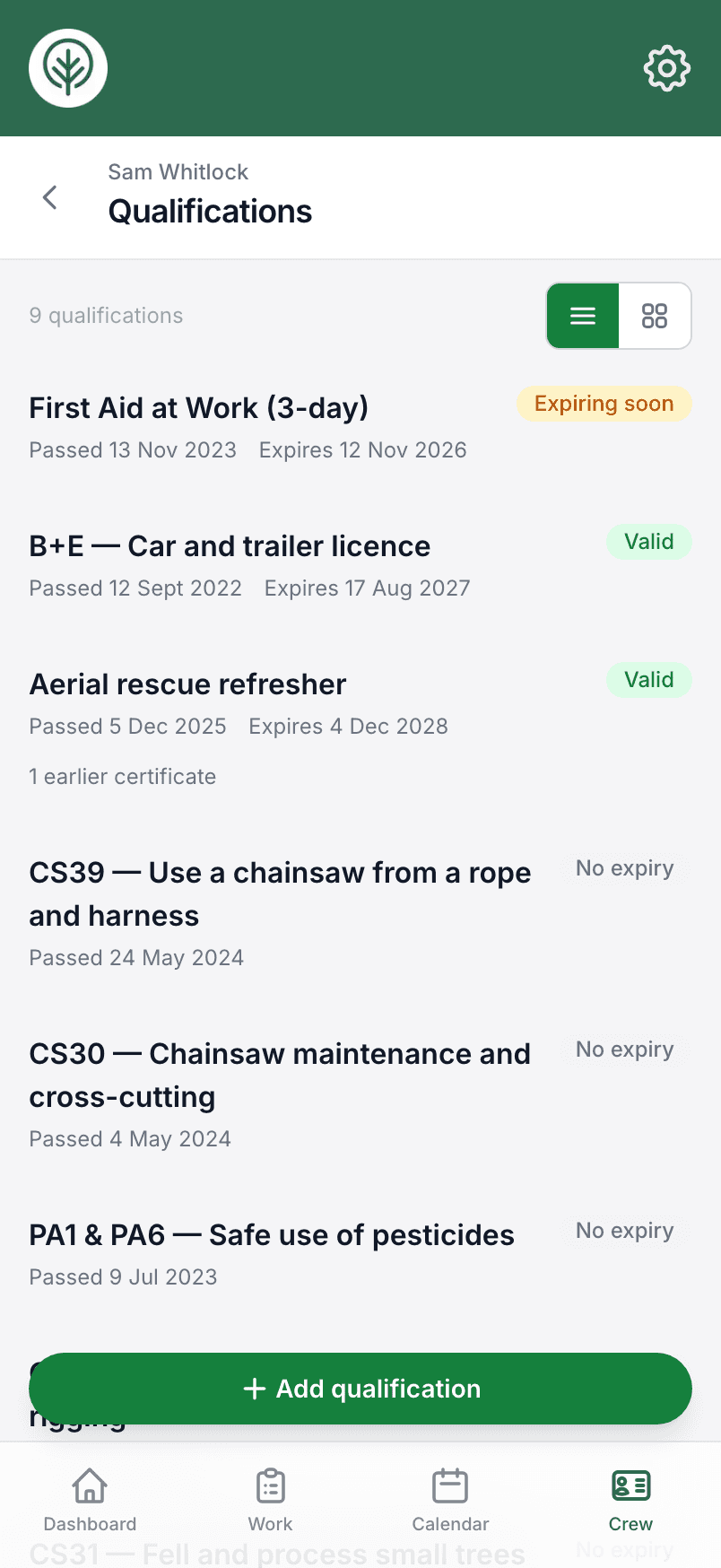
Add each certificate with a scan of it, and choose how far ahead you want a reminder. The dashboard shows tickets coming up for renewal, the Monday email lists any expiring in the next 30 days, and recording a renewal keeps the old certificate in the history.
Qualification numbers and titles change from time to time. Check the current unit with City & Guilds NPTC, Lantra Awards or your training provider before booking training.