
What’s on the form
One assessment for every job, plus add-ons.
The template is built from a working tree surgery firm’s paper form. It’s five A4 pages:
- The job: business, customer, site, crew names and the weather.
- 10 common hazards, each with who's at risk and typical controls filled in, and boxes to score likelihood and severity.
- Checklists for site set-up and welfare, PPE, health and COSHH, wildlife and TPOs, and emergency arrangements, including the nearest A&E and who the first aider is.
- 7 add-on sections, filled in only when the job needs them: roadside work, climbing and aerial rescue, chainsaws, rigging, MEWPs, cranes, and chippers, stump grinders and plant.
- A sign-off section for the crew to confirm they've been briefed.
How to fill it in
On site, before anyone starts work.
- 1Fill it in on the day, at the site. The weather, parked cars and people walking past are different from the day you quoted.
- 2Score each hazard with the controls you're going to use in place: likelihood × severity, each from 1 to 5.
- 3Write down anything specific to this site in the blank lines, such as a glasshouse under the drop zone or a nest in the crown.
- 4Go through the checks. A No means something needs sorting before work starts. Use N/A where a check doesn't apply.
- 5Complete each add-on the job needs and leave the others blank.
- 6Brief the crew on the hazards, the controls and the emergency plan, then everyone signs.
- 7If conditions change during the day, stop and update the assessment.
Scoring
Likelihood × severity.
Each hazard gets a likelihood and a severity from 1 to 5. Multiply them for a score out of 25, and the score puts the hazard in one of four bands.
Likelihood
- 1 Very unlikely
- 2 Unlikely
- 3 Possible
- 4 Likely
- 5 Very likely
Severity
- 1 Minor (first aid)
- 2 Minor injury
- 3 Lost-time injury
- 4 Major injury
- 5 Fatal
The law
Does it have to be written down?
Under the Management of Health and Safety at Work Regulations 1999, every employer has to assess the risks of the work. If you employ five or more people, you must also record the significant findings.
Below five, the law doesn’t require it in writing. A signed assessment is still the record that shows the crew were briefed, and it’s what councils, managing agents and main contractors ask for. The form follows HSE’s five steps: identify the hazards, decide who might be harmed, evaluate the risks and controls, record what you found, and review it.
Many firms also keep a general risk assessment and method statement for each type of work, such as climbing, felling or stump grinding. This template is the site-specific one, filled in on the day.
In Treetask
The same assessments on the crew’s phones.
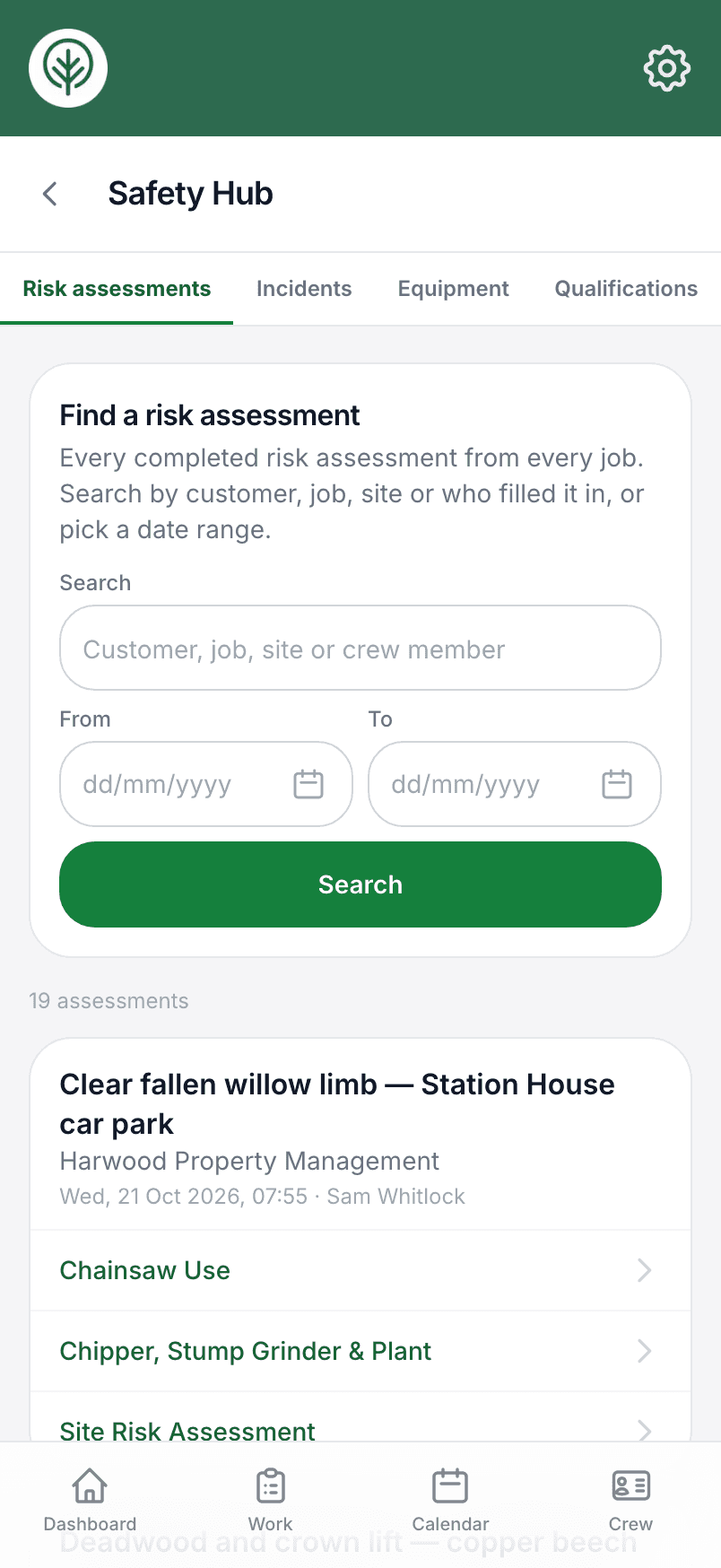
Treetask has these assessments built in. On the job, tick the ones that apply, fill them in as one form and everyone signs on the screen. It works with no signal, and the office can download a PDF of any job's assessments when a client asks.
This template is a starting point. Check it covers the work you do and matches your own method statements before you use it.